Take time out of your busy day and make a Donation to an amazing cause. Shed some light on Heart Awareness

1300 343 278

This Atrial Fibrillation Awareness Week, Hearts4heart is encouraging Australians to get to know the signs of atrial fibrillation (AF), understand the potential impact and know when to take action.


An estimated half a million Australians are living with AF, an irregular pulse or heartbeat.1,2 The condition can increase the risk of stroke, with one in four strokes attributed to AF. Yet despite this risk, only 41% of Australians know an irregular heartbeat can increase their risk of stroke.3


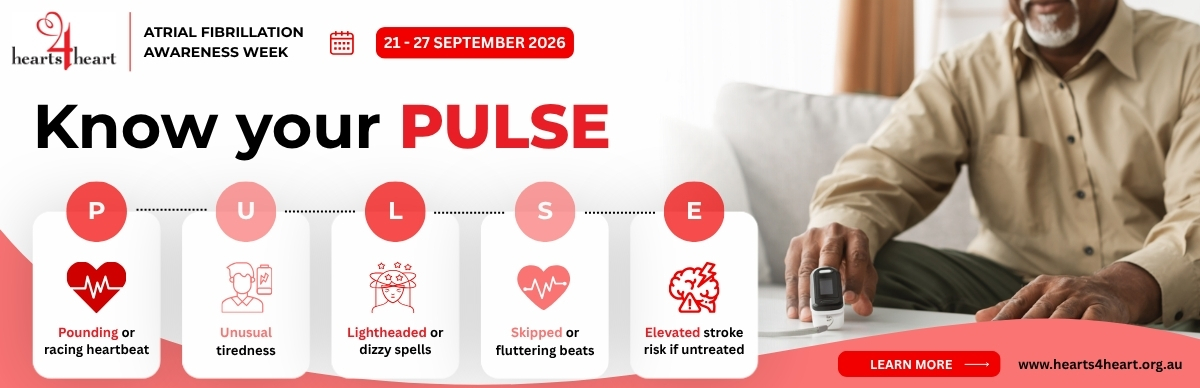
New research* commissioned by Hearts4heart found just 2% of Australian adults can correctly identify all four key AF signs – a pounding or racing heartbeat, unusual tiredness, light-headedness or dizziness, and skipped or fluttering beats.3

Introducing PULSE

Knowing what to look out for can help people recognise when something may need further attention.

That’s why this Atrial Fibrillation Awareness Week, Hearts4heart is launching PULSE – a simple acronym to make the key signs of AF easier to spot and remember, while helping Australians understand the potential impact if AF is left untreated.

If something doesn’t feel right, speak to a GP or healthcare professional about your symptoms and heart health. You can also learn how to check your pulse and become more familiar with what is normal for you.

Do you know how to check your pulse?
 

In this video, Dr Geoff Lester demonstrates this simple, potentially lifesaving skill. Watch and follow him as he takes you through the steps.

If a very slow or very fast pulse is detected, visit your doctor and request a heart check with a stethoscope.

What is atrial fibrillation?


AF is when the heart’s upper chambers, the atria, beats abnormally. It occurs when there is a disturbance to the heart’s electrical system, resulting in an irregularly irregular pulse or heartbeat.1 This means the heart is not pumping blood around the body as well as it should, often leading to increased risk of stroke, heart failure or dementia.1,2


It is associated with high blood pressure, heart disease, obesity, alcohol consumption and other comorbidities such as type 2 diabetes and lung cancer.3 Increased risk can also be seen in some families.

AF can affect people in different ways and typically starts as short episodes, which can then become longer attacks overtime. This may eventually develop into permanent atrial fibrillation.

What are the symptoms of atrial fibrillation?

AF can affect people differently, and some people may experience no symptoms at all. In addition to the key signs included in PULSE, other symptoms may include:
  • Rapid heartbeat or palpitations
  • Tiredness
  • Fainting
  • Chest pain
  • Dizziness
  • Shortness of breath
  • Swelling of the ankles
Treatment/management
 

Treatment for AF will depend on your symptoms and individual risk factors and may include medicines, procedures or other approaches recommended by your healthcare professional.


Treatment options can include:


Catheter ablation:
  • This minimally invasive procedure targets the areas of the heart that are triggering the abnormal beats to prevent AF from happening.
Drug therapies:
  • prevent blood clots forming (anticoagulants). This reduces the likelihood of having a stoke
  • slow the heart down can reduce symptoms of AF.
  • return the heart back into regular rhythm.
Electrical cardioversion:
  • an electrical current is applied through gel pads on the chest to try to get the heart to beat normally.
Know the signs. Know when to act.
 

If you think your heartbeat may be irregular or something doesn’t feel right, speak to a GP or healthcare professional about your symptoms and heart health.

Hearts4heart has developed a range of resources for all Australians to read and share with their families and friends:

About Atrial Fibrillation Awareness Week 2026
 

Atrial Fibrillation Awareness Week is a national Hearts4heart campaign raising awareness of the signs, diagnosis and complications of AF and helping Australians better understand when to take action.


This year, Hearts4heart is launching PULSE, alongside CEO Tanya Hall and Australian AF experts, to give Australians a simple way to remember the key signs of AF and understand the potential impact of the condition.


Atrial Fibrillation Awareness Week runs from  21–27 September 2026.

Tanya Hall
Dr Warrick Bishop
Dr Geoff Lester
Dr Kushwin Rajamani 2
Dr Kushwin Rejamani

How can I donate?

Hearts4heart relies on the generosity of people like you to help us to continue our important work providing targeted educational programs, resources and services to improve heart failure diagnosis in Australia.
*About the nationally representative survey
The data by Raw Data – MediaCast Pty Ltd – Atrial Fibrillation (A-95551) Aug’26 was carried out on a sample of 1,009 Australians in August 2026. The data sample swas weighted against Australian Bureau of Statistics (ABS) data for age, gender and location using an online survey that was independently conducted and verified by PureProfile