
Take time out of your busy day and make a Donation to an amazing cause. Shed some light on Heart Awareness
Pacemakers have their origins right here in Australia; almost 100 years ago, the first pacemaker was invented by Dr Mark Lidwill at the Royal Prince Alfred Hospital. Around 20,000 cardiac rhythm management devices are implanted every year across the country, and most (three-quarters) are pacemakers1.
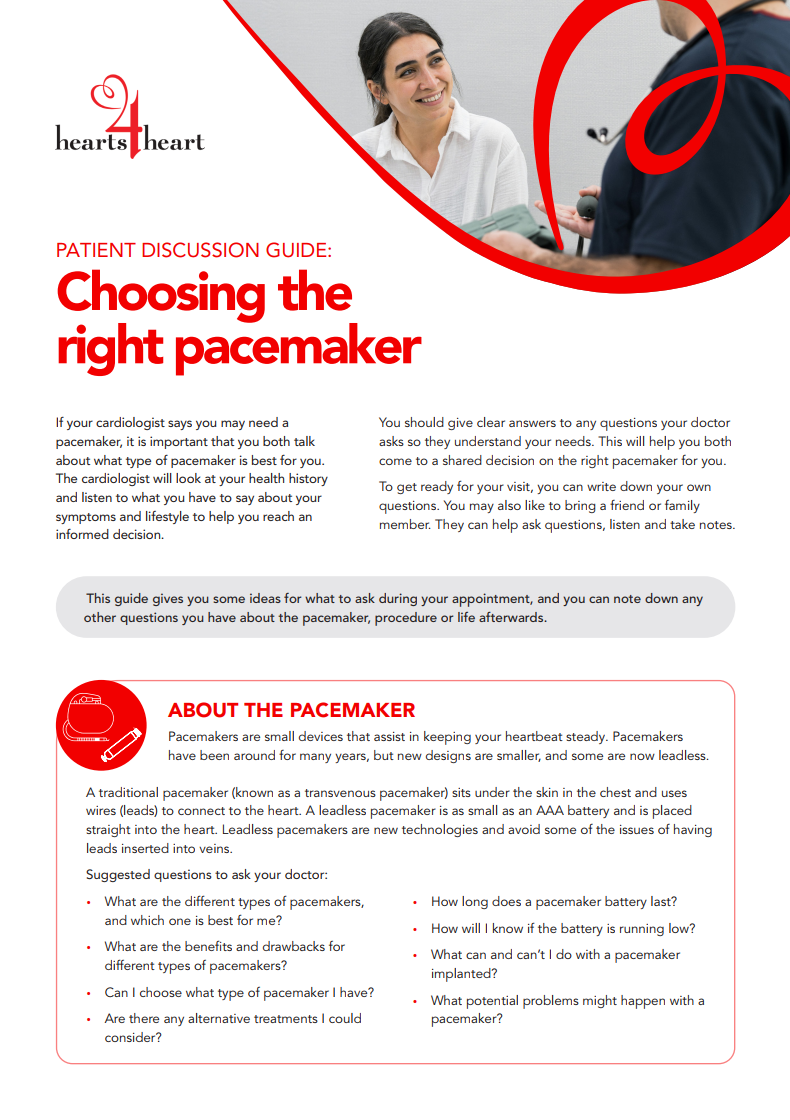
Your downloadable patient discussion guide.
Traditional pacemakers (transvenous pacemakers) connect to the heart through thin wires, but recent technological innovations have led to the introduction of new pacemakers that don’t have any wires. These are known as leadless pacemakers.
Meet Khulood Rizvi as she shares her personal journey with a leadless pacemaker, while her cardiologist explains the procedure and the latest leadless pacemaker technology.
Pacemakers are used to treat heart conditions such as a slow or irregular heartbeat and special pacemakers can treat heart failure. A traditional pacemaker (transvenous pacemaker) is implanted through the chest with a battery below the collarbone under the skin, and into the heart via a blood vessel, with the wires (leads) attached to the battery. The wires (leads) are placed into one or both of the heart’s chambers. These chambers are called the atria (the smaller top chamber) and the ventricle (the larger bottom chamber).
Leadless pacemakers are placed directly into the heart and inserted through a vein in the groin using a tube (catheter). They can be implanted as a single unit or two pacemakers can be implanted together, one in the top chamber and one in the bottom chamber. They can be wirelessly connected and work together to help the heartbeat in time; this is called ‘dual chamber pacing’. Leadless pacemakers are generally associated with less infection risk compared to transvenous or traditional pacemakers.2
Not everyone who needs a pacemaker will be able to have a leadless pacemaker. They are available at many hospitals in Australia but not all. A leadless pacemaker may not be suitable for everybody, and the decision about which pacemaker to have should be a shared decision between the doctor and the patient, based on a range of factors including the patient’s needs, lifestyle, and medical history.
While traditional and leadless pacemakers address the same heart conditions by regulating the heartbeat, leadless pacemakers have been designed to eliminate some of the possible health complications. This is possible because leadless pacemakers do not have wires or a space under the skin of the chest (known as the ‘pocket’) where the device is implanted. While traditional pacemakers are commonly used, occasionally pacemaker wires can create problems if they move or break, and if this happens the patient may need another operation. If the space where the pacemaker is implanted gets infected, the patient might need further treatment. Leadless pacemakers have been developed to reduce these risks.
Studies have shown that the recovery time for people who have been implanted with leadless pacemakers is shorter than that of those who receive traditional pacemakers, and it is typically easier for doctors to remove or replace them in the future, if needed.
Pacemaker batteries last a long time. Traditional models can last around 10-15 years and some leadless models can have an even longer battery life of up to 18 years.3 This means people who have leadless pacemakers won’t need as many replacement procedures.
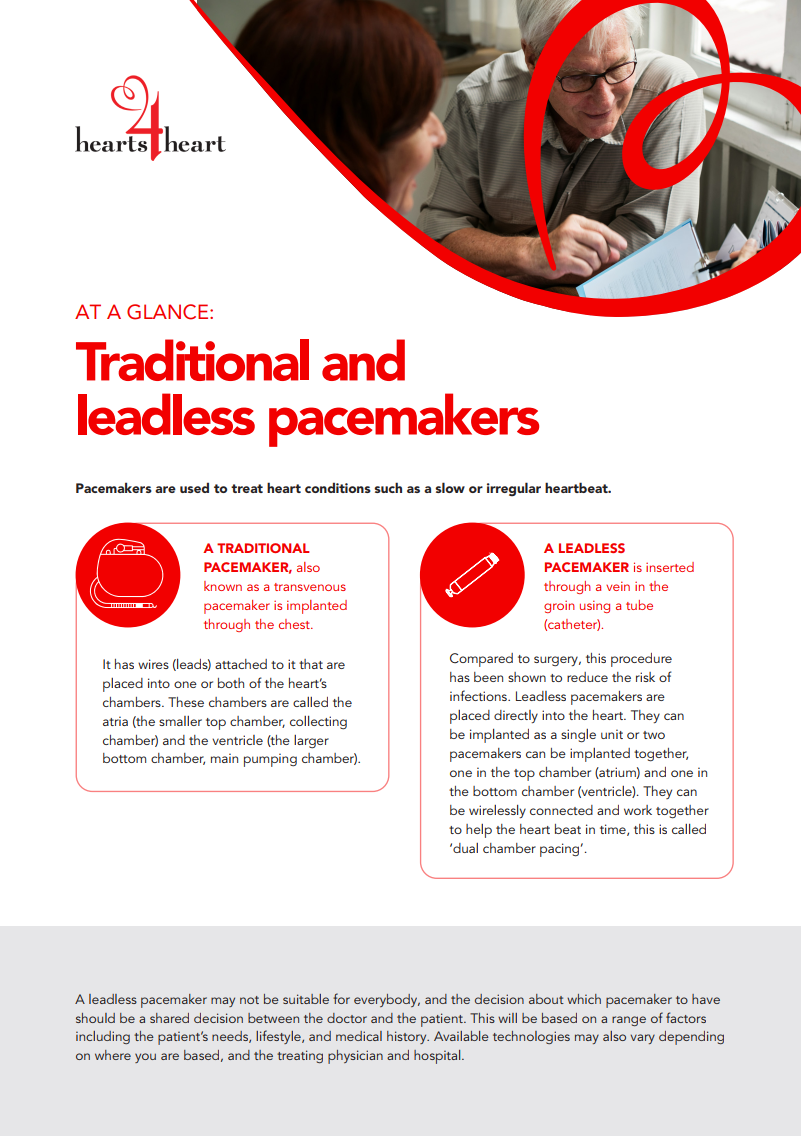
To learn more about leadless pacemakers.
While atrial fibrillation (when the heart beats irregularly) is a common condition that may be treated with a pacemaker, there are other conditions that may require the implantation of a device. These conditions include:
As always, if you are concerned about any of these conditions, have noticed any symptoms or changes in your general health, speak to your GP or cardiologist.
When the heart beats too fast or too slowly, this disrupts the supply of blood to other parts of the body. This disruption could potentially lead to strokes, fainting or even heart failure. Signs you may notice when your blood supply is being disrupted can include fatigue, being unable to breathe, feeling dizzy, or blackouts, making even normal activities difficult. Pacemakers, whether traditional or leadless, help control the supply of blood by regulating the heart’s rhythm.
Australia’s first leadless pacemaker was introduced in 2015. The latest versions of leadless pacemakers are smaller than an AAA battery and can last in the heart for up to 18 years3.
As the technology is still quite new (in medical terms) leadless pacemakers are available at many hospitals in Australia, but not all. A leadless pacemaker may not be suitable for everyone and this needs to be a shared decision between you and your doctor about what is best.
The cardiologist inserting a traditional pacemaker will make a cut (incision) in your chest to place the pacemaker inside. The leads or wires are implanted in the heart through a tube (catheter) and connected to the pacemaker.
A cardiologist inserting a leadless pacemaker will insert the device directly into the heart through a catheter that goes through your vein via the groin. This method reduces the risk of infection and complications associated with the wires as no incision in the chest or pacing leads or wires are needed.
After a procedure you will need time to recover, your recovery time is based on the type of pacemaker that has been implanted. A traditional pacemaker will require around two weeks of minimal shoulder activity and four to six weeks without participating in a lot of physical activities to avoid the risk of leads becoming dislodged.
However, people who have been given a leadless pacemaker should be able to resume an active lifestyle within a week of their procedure. The restrictions to lifestyle are generally much less with leadless pacemakers.
Your life may change following the insertion of a pacemaker, for example:
When you are walking through airport security present your pacemaker/device card to the security staff and avoid the old-style walk-through metal detectors. If you inadvertently walk through do not remain in the detector. You should also inform staff you have a device and show your implant ID card if security staff examine you. Hold your hand over your chest to avoid a security wand getting too close to the device.
References